How to earn from amazon FBA
- Get link
- X
- Other Apps
.png?width=50&height=50&name=feedbackfive-menu-icon(orange).png "FeedbackFive icon")
.png?width=50&height=50&name=marketscout-menu-icon(orange).png "Marketscout icon")
.png?width=50&height=50&name=restockpro-menu-icon(orange).png "RestockPro icon")

Starting an Amazon FBA business is a great opportunity to boost your sales. Although the list of benefits is long, here are a few facts that will definitely catch your eye:
- You get to be your own boss and run your entire business from the comfort of your home.
- Amazon handles all things related to customer service so you can focus your efforts and attention in key aspects to develop your company, like paid advertising and A+ Content.
- You manage your business on your own terms and at your own pace.
In this article we’ll show you the right way to choose your products, how to make money on Amazon FBA, and the advantages of selling on the most important eCommerce platform in the world: Amazon.
Is Amazon FBA Profitable?
It sure is! And it seems it will continue to be so for many years to come.
However, you must keep in mind that your business’ success won’t solely depend on FBA’s fine-tuned machinery but on a series of key aspects such as:
- Your performance as a seller (responsiveness)
- Marketing strategies (social media presence, PPC advertising, high-quality images, etc.)
- Product quality, innovation, and availability
Best Product Sourcing Strategies
There are a couple of options for product sourcing, depending on the business you want to run. The most important thing to consider when choosing what products to sell through your online store is to make sure people actually want to buy them.
Do a little research on the trends and check which products are selling best.
The most popular ways of sourcing products are:
1. Retail Arbitrage
 The whole purpose of this practice is to get you started as an Amazon seller with the minimum investment; so, first, you’d want to set up an Amazon individual seller account as it doesn’t require any monthly fees.
Although this practice does not require a lot of resource investment, it certainly takes time. You can take the following steps:
- Find various products that sell well on Amazon. Focus on products that have a decent amount of reviews. That means people are buying them.
- Browse other stores for the same products at a cheaper price and buy them.
- Sell them through FBA.
Note: We recommend to fulfill orders yourself using Fulfilled By Merchant (FBM) at least during the first quarter of your selling journey. As you gain more experience, you may want to try FBA as your fulfillment option.
The toughest part about retail arbitrage is to actually find bargains. Many resellers find great deals while late-night shopping.
Also, Amazon offers an FBA Calculator that lets you input your prices to calculate exactly how much you’ll be paying for storage and shipping fees.
That way, you can have a clear idea of your profit margins and you’ll avoid making a risky investment with products that might not be worth it.
2. Wholesaling
This product sourcing strategy has to do with buying bulk, discounted products to resell on Amazon. It is a little more competitive, but tends to also be easier. Depending on the size of your business and the inventory possibilities you have, wholesaling could be very lucrative.
3. Private Label
This is when you create your own brand of manufactured products. You need to learn a bit more to be able to sell using this method. In the long run, it’s less time-consuming, far more profitable, and potentially comes with less competition.
How Does Amazon Private Labeling Work?
It is actually not that hard.
 Amazon private labeling allows sellers to sell their products using their own packaging despite the fact that they were manufactured by someone else--with the manufacturer’s consent, of course.
The first thing you have to do is to create a brand. If you want to be taken seriously and actually stand out, you’ll have to look professional.
We suggest you start with the following list to make an impact on buyers:
- Get a domain name for your brand that is the same as your FBA business.
- Set up an email address at your domain.
- Have a domain and a web page.
- Get a logo or just use text.
- Get yourself an eCommerce store, you’ll want to have this in place later on anyway.
After making sure you have a brand set up, the process can be summarized in a few simple steps:
1. Product research
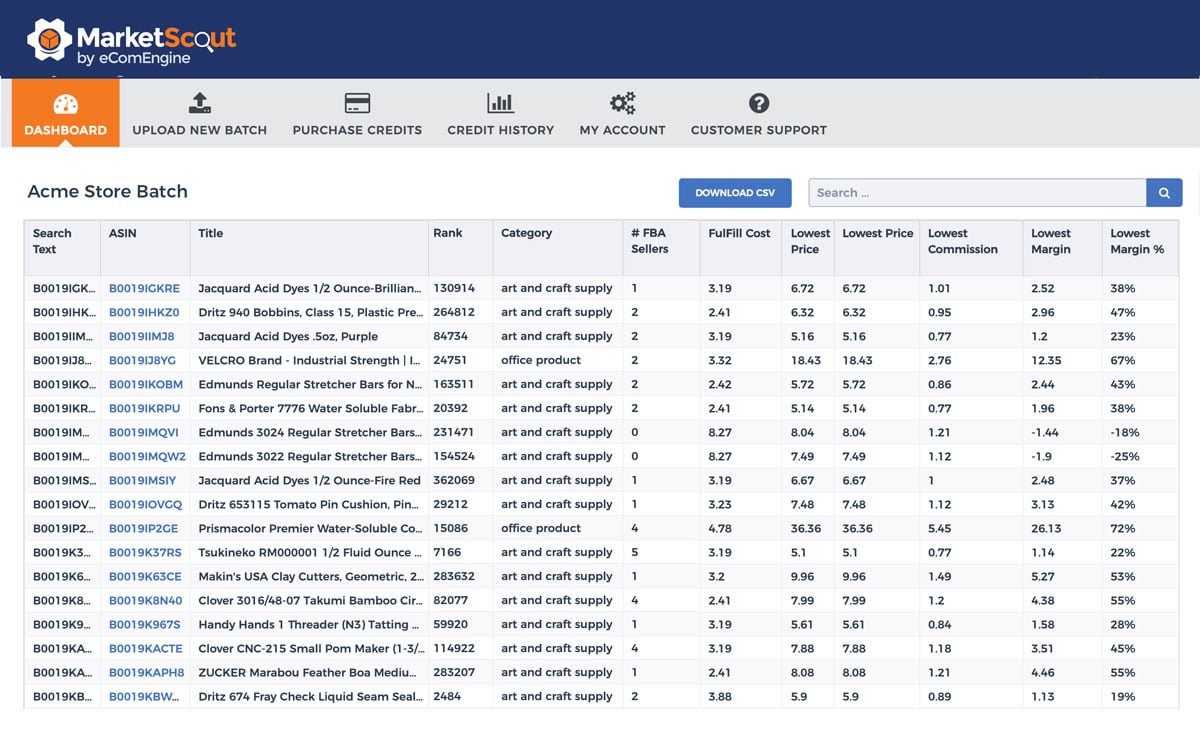
You can use product research software like MarketScout to find the best-selling products on Amazon and identify trends.
2. Sourcing
Once you’ve decided on what type of product you’d like to sell, source it through a manufacturer like Alibaba.com:
- Sign up for a free account in Alibaba.
- Fill in your profile (as your business)
- Search for the type of product you want
- Browse the results and pick a few potential manufacturers
- Get in touch with them! Introduce yourself and your brand and inquire how much it would cost to send you a sample.
Try to get the samples from different manufacturers to decide on the best product for you. Pay attention to quality. You don’t want any returns or bad reviews.
3. Create a listing
Once your product is being manufactured, you’ll want to build a brand-new Amazon product listing through Amazon Seller Central.
If you’re starting small, you can use an individual seller account that will charge you per purchase. When you sell more, you can upgrade to a professional seller account.
4. Send your stock to FBA
Amazon has everything set up so you can print the labels you need and just request a pickup. You can easily do it from your Seller Central account.
If the manufacturer did not include good quality images, get some good pics yourself. At best, send a product to a local photographer.
5. Launch your product
Once your product hits an Amazon Fulfillment Center, you can start advertising your product directly from Amazon Seller Central.
You don’t have to write a title or a description. Just tell the wizard what product you want to advertise, set your daily budget, and that’s it!
The rest is on you. Make sure to provide such a service that your customers are left with no other choice but to leave a great review. This is the best way to drive organic sales growth by reaching potential customers.
How Much Money Can I Make with Amazon Private Labeling?
While there is no specific number, on average, a good private label product should sell between 250-300 units per month--if listed correctly.
When calculating your profit margins, keep in mind you should earn $8-$15 per sold item in profit, after subtracting Amazon fees, advertising costs, and the actual cost of the product. That means that if you do your homework, the average Amazon private label product should earn $2,000 – $4,500 per month.
Make Money on Amazon FBA with a Business Plan
True success will come if you have a functional plan that is transparent and measurable, willing yet flexible, and open to leveraging your competitive advantage. That is why Amazon provides its sellers with an FBA Business Plan tool.
An Amazon FBA business plan template works as the internal roadmap for starting and growing your business. It’s essential to establish the groundwork required and to streamline your business positioning. Basically, it is a step-by-step process to help you achieve your goals.
1. Executive Summary
This is how you structure your business plan. Introduce your business and brand. Communicate who you are and how you’re here to help.
2. Company Description
In this section you can include your mission and vision, company formation information, founders, location, and notable achievements. It features three important sub-sections, which you’ll have to complete: Main Objectives, Products or Services, and Value Proposition.
3. Marketing Plan / Analysis
All sections can be customized, but this one may require the most tweaking. Every business needs a different strategy. Explain in detail which marketing activities need to be done, how they will be executed and future goals into your Amazon FBA business plan.
Here, you’ll have the choice to select fields such as target market size, total addressable market (TAM), SWOT Analysis (Strengths, weaknesses, opportunities, and threats), or even an Estimates of Cost Per Action of any testing conducted, which can include cost per click, cost per conversion, sampling costs, and more.
4. Operational Plan
Organize the different parts of your business and allow for a practical understanding of the industry and your products.
5. Management & Organization
Here’s where you can talk about your management and industry experience. You can provide a rundown on the assigned people for each task and flaunt their resumes to show off your team.
6. Financial Plan
This is where you show your current financial state, thorough startup cost, forecasts, and goals. This is to provide secure funding of what you need and a product/business development budget. You can include information regarding: revenue streams, cost structure, current balance sheet, cash flow projections, expense projection, etc.
7. Appendices
This includes all supporting information like articles of incorporation and company status, shareholders’ agreement and company constitution, resumes of founders, and key team members, or deeper research data, or links to references.
In summary, your Amazon FBA business template should be kept short, simple, and straightforward.
Turn Your Business into a Sales Machine
Amazon FBA is a great tool when used properly. It can steer sales your way since your listings will be easier to find, your products will gain visibility, and you’ll keep customers happy, thus getting good reviews.
It’s just a matter of understanding what your business needs and how you can achieve that. A well-crafted Amazon FBA business plan can help you get an idea of where you are standing and where you want
- Get link
- X
- Other Apps
Good info
ReplyDelete